Z-News out
of Judea
Brought to you by Zahava Englard of One Israel Fund
On the road again with Marc Prowisor.

Starting out bright and early, I’m on the way down to the
southern hills of Hevron with Marc Prowisor, chief of security projects for
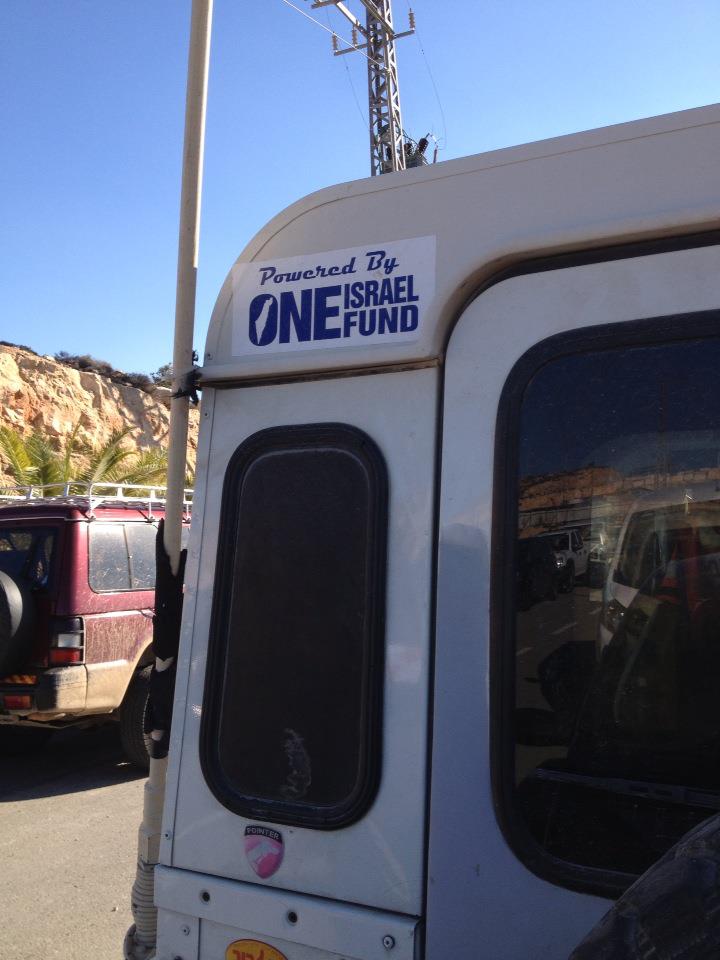
OIF. The jeep Marc drives, it’s back loaded down with a myriad of security and
emergency medical supplies, greets the bumps on the road with a dull heavy
thud. We stop at the Gush Etzion junction just south of Efrat to meet Ofer, the
head of Hatzola Yosh. Marc opens the trunk of his weathered jeep and lugs out a
bounty of emergency medical kits that OIF acquires thanks to the generous
donations from our supporters.
.

There is one goal, which is to keep Judea and Samaria
flourishing for the Jewish people. Building and further developing the
communities along with proper security provisions can accomplish this.
 To this end, One
Israel Fund is dedicated to the safety of all the residents in all of the communities
throughout Judea and Samaria and it makes sense to work in conjunction with
others who feel the same way. Hatzolah Yosh, Tatzpit, Regavim are three such
groups that OIF is proud to work with. It is the perfect prototype of achdut, unity.
To this end, One
Israel Fund is dedicated to the safety of all the residents in all of the communities
throughout Judea and Samaria and it makes sense to work in conjunction with
others who feel the same way. Hatzolah Yosh, Tatzpit, Regavim are three such
groups that OIF is proud to work with. It is the perfect prototype of achdut, unity.
Before leaving the junction, we meet an Israeli soldier from
the Kfir unit working his beat. Marc notices that the shluker/camelback he is outfitted with is one
of ours, the One Israel Fund emblem proudly stamped onto it. “We gave these out
a couple of years ago,” Marc says pointing to the smiling soldier’s shluker.
“It’s good to see how well they’re holding up.”
We wind our way back up the road to Caliber 3 tucked off the
road northwest of Efrat where Marc speaks with a group of ravshatzim, heads of
emergency response teams in Judea who are there for security training, a
project funded by OIF. Assessments are made as to what type of security
equipment is needed by each response team.

The surveillance equipment we provide is cutting-edge. With
the information we gather from the response teams in the field, OIF works
together with our manufacturers in making the
necessary technological revisions. Our suppliers will update equipment and
provide special components, modeling the equipment according to our specific needs.

Subsequently,
the IDF has taken notice of what we are doing and the Home-Front Command is
interested in working together with us in securing the civilians of Judea and
Samaria.
Marc and I continue on highway 60 towards Kiryat Arbah. We
stop at the gas station there that houses a small grocery store. I need a quick
chocolate fix and Marc needs another coffee. From there we head further south
towards Yatir, a community of over one hundred families that boasts an
outstanding mechina, a pre-military yeshiva headed by Rav Moshe Hagerlow, a
former Division Commander in the IDF. At the mechina, his students are highly
motivated with love of the land and social activism. They regularly do farm
work and gardening in the community as well as volunteering to help another
local farmer in the area, a widow by the name of Dalya Har Sinai, whose husband
was killed by Arab terrorists. Despite ongoing threats, she is staying put and
OIF protecting her is a big reason why. In addition, the students volunteer in Sderot
and in hospitals.
At Yatir, we also meet with Shai, the director of the
mechina who informs us that they badly need an exercise room for the students
who wish to train before their army service. Many of these young men strive to
serve in elite units. We’re told of three brothers who graduated from the
mechina, each of them going on to become pilots. Shai shows us around, and we
meet several students working in the kitchen, mostly city kids who are now
experiencing a hands-on approach in connecting to the land, thanks to Yatir’s
mechina.
We wind our way outside and up a metal staircase bringing us
to a look out point that affords us a stunning panoramic view of the
surrounding hills with the village of Sussia in the distance as well as the Carmel
winery. Shai asks for One Israel Fund’s help in providing the funds toward the
exercise room. He also tells us that Yatir’s ambulance is lacking some crucial
equipment.
Marc instructs Shai to make a list of what he needs before
we continue to the southern Hevron city council to meet Dan, the Regional
Director of security in the Hevron Hills. He’s been waiting there for us to
bring the shopping list
of security equipment that each of the ravshatzim in the area requested for
their response teams. It was getting late in the day, when Dan joins us and
further discusses the type of security equipment that he requires. “Don’t say
another word,” Marc tells him. “I know just what you need”. He follows us to
the jeep and Marc shows him one of the latest state of the art mini
surveillance cameras. Chanukah may be over, but Dan’s eyes widen, excited with
this latest gift from OIF to add to his security arsenal.
In our travels, we discover a surprisingly large and
successful cosmetics manufacturer who not only is a major exporter but he is
the third generation of his family in the area and he employs Jews as well as
Arabs to work in his factory. Marc and I walk through this wonderful find,
uplifted by the living example of coexistence in the southern Hevron hills.
All in all, a good productive day.
The sun is just about to set when we head back home, passing
by several Jewish communities along the way − most of them, secular while
some are mixed. I indulge myself in a
nap as Marc drives north. About a half
hour later, he drops me off in Efrat and continues home to Shilo with an entire
new list of requirements and security assessments for the Judea region.
There is an answer. One Israel Fund.
Be a partner with us!

 One Israel Fund, dedicated to providing humanitarian and security assistance to the Jewish communities throughout Judea and Samaria, is pleased to show the heartland of Israel to all who wish to visit. The day trips are enlightening, engaging, inspiring, heartening and entertaining!


